

A lot of people who buy a gym membership in January have stopped going by March, and few of them quit because the gym was bad. Getting there took forty minutes on a Tuesday, and the couch was closer.
Equipment and atmosphere both matter, but the setting that works is usually the one that removes whatever stopped you last time.
This comparison is about training at home versus a commercial gym or an independent studio. A gym inside your condo building has its own rules and is covered on the condo gym personal training page.
In-Home Personal Training vs Gym: The Short Verdict
In-home training wins when your obstacle is logistics: time, travel, young kids, or not wanting to train in front of strangers. A commercial gym or studio wins when your goal needs heavy equipment, or when leaving the house is part of what gets you training at all.
Which one is better depends on which of those problems you have. If it’s the logistics, the in-home personal training service page shows what a trainer brings and how sessions are set up.
How the Two Settings Differ
The same trainer can coach you the same way in either place. The table covers what changes around the session.
| In-home | Commercial gym or studio | |
|---|---|---|
| Travel | None for you | Yours, both ways |
| Equipment | What the trainer brings plus what you own | Racks, cables, machines, heavy loads |
| Privacy | Complete | Shared floor, varying by facility |
| Scheduling | Built around your day | Built around the facility’s hours and peak times |
| Distractions | Household ones | Other people’s |
| Training between sessions | Limited to what you own | Full equipment, on your own time |
The distractions row is the one people underestimate. At a gym it’s someone hovering by the bench you’re using. At home it’s a courier at the door or a child who wakes up halfway through. Trainers who work in homes regularly are used to the second kind, and it’s fair to ask how they handle it before you commit.
Where In-Home Training Wins
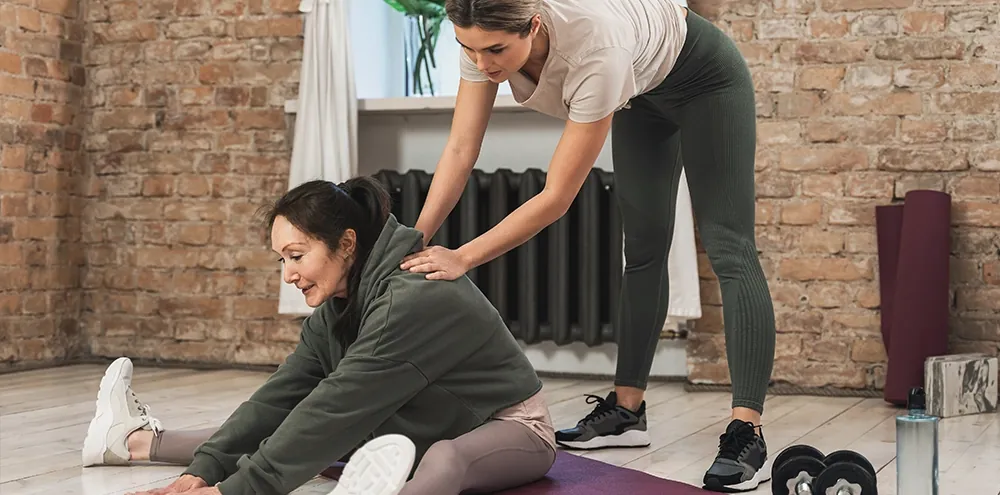
You don’t travel. A 6:15 a.m. session starts when you open the front door, so there’s no drive to talk yourself out of and no bag to pack. People with an unused gym membership usually try in-home training for this reason alone.
Nobody watches you train except the trainer. That matters most to people learning movements for the first time and to anyone coming back after an injury, a pregnancy or a long break.
A trainer who comes to you can schedule around a school pickup or a shift pattern, which a busy gym’s peak hours can’t do. For parents of young kids, a session in the living room after bedtime is often the only one that happens.
In January and February the gap widens. On a morning of freezing rain, a gym session means clearing the car and driving on bad roads, while an in-home session means the trainer does the driving. Storms still cancel some in-home sessions, so ask how a trainer handles weather cancellations.
Training at home teaches you to train with what you own. When your trainer is on holiday or you’re travelling, you already know which exercises work with the dumbbells in your closet.
Where the Gym Wins
A gym has equipment you can’t fit at home. To get strong on a barbell squat or deadlift you eventually need a rack, a bar and more plates than a trainer can carry up your front steps. Cable work and sled pushes need a gym too.
It also has room. Carries, walking lunges and overhead presses need floor space and ceiling height. A living room in a semi in the Beaches handles most of that; a narrow townhouse with low ceilings and hardwood you don’t want dented handles less.
Some people train better away from home, because the house is where their work and family are and a separate space is what gets them into training. If that describes you, a trainer at your door won’t change it, and it’s worth admitting that before you book.
Many studios run small classes or open-gym hours alongside one-on-one coaching. That gives you a structured place to train on the days between sessions, with the same equipment your program uses.
What an In-Home Session Needs From Your Space
Floor space is the first thing a trainer will ask about. About two metres by two metres of clear floor covers most dumbbell and bodyweight work. Walking lunges and carries need a hallway or a longer room.
The floor matters as much as its size. Hardwood and laminate need a mat or a couple of rubber tiles under anything heavy, and a finished basement with low joists rules out overhead presses for anyone tall. If you share a wall in a semi or a townhouse, or live above someone in a duplex, dropped weights carry. Trainers plan around that by choosing movements you can lower under control instead of dropping.
Equipment needs somewhere to live between sessions. Some trainers bring everything and take it away again; others ask you to buy a few pieces so the program doesn’t depend on what fits in their car. Ask which way a trainer works before the first visit, and whether setup and pack-up happen inside or outside the paid hour.
Can You Build Real Strength Without a Gym?
You can build muscle without one, and a fair amount of strength. Lighter weights taken close to failure build roughly as much muscle as heavy ones, because muscle responds to effort relative to what you can handle. Maximum strength is different: it improves most with heavy loads.
A 2017 meta-analysis led by Brad Schoenfeld found that pattern across the studies it pooled, with similar muscle growth at low and high loads and larger strength gains at high loads. So a pair of adjustable dumbbells and a trainer who changes tempo and rest periods can keep a beginner or returning lifter progressing at home for months.
The limit comes sooner for people who are already strong. Once you can press or row the heaviest dumbbells you own for more reps than a set should have, you can buy heavier ones, add a gym, or keep what you have and maintain. Plenty of people choose to maintain, and it helps to know in advance that you’ll reach that point. If strength is your main goal, talk to a trainer about how far dumbbells and bands can realistically take you.
How to Tell Which One You’ll Keep Doing
Start with why you stopped last time, if you have. That reason usually predicts the next attempt better than a list of pros and cons.
Take a parent in Richmond Hill with two kids under six (a composite of a common situation, not one client) who kept a gym membership for a year and went four times. Every possible training window started with a twenty-minute drive and ended with paying a babysitter, so in-home sessions solved a travel problem they had been treating as a discipline problem.
It works the other way for some people. If you work from home, a trainer arriving at the kitchen table where you’ve spent eight hours on calls can feel like one more meeting, and a studio gives you a different room to train in.
A few questions sort most people:
- What has ended your training before: travel and time, or motivation once you got there?
- Does your goal need heavy barbell work in the next six months, or will dumbbells and bands carry you that far?
- Do you have room for a mat and a bench, with nothing breakable within arm’s reach?
- Will you train on your own between sessions, and if so, where?
Many people combine the two: one or two in-home sessions a week with the trainer, plus a gym membership for the days they train alone. That covers the travel problem and the equipment problem at once.
If you still can’t tell, try a month of in-home sessions and count. If you trained more often in those four weeks than in any month of the membership, the setting was the problem.
Getting Started at Home
If your situation looks like the Richmond Hill one, a trainer can usually tell in one visit whether your space works and which equipment, if any, is worth buying. With Trainer Pro, that first visit is free.
Book a free first session with an in-home trainer and mention your floor space and any equipment you already own, so the first session is planned around them.