
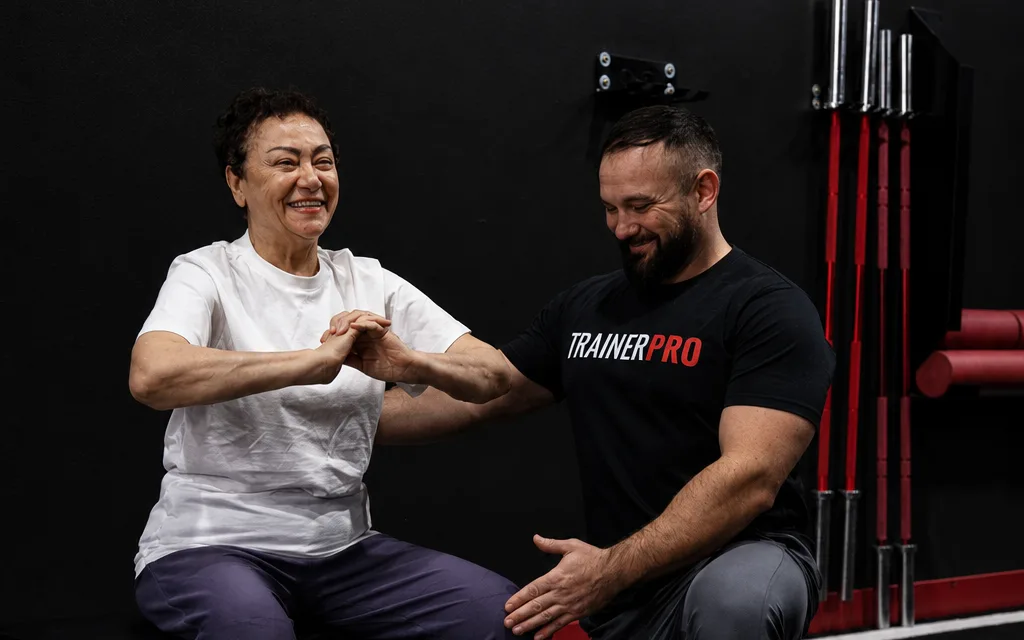
Chair exercises for seniors have a reputation as the easy option, the thing you do when “real” exercise is off the table. That undersells them. A sturdy chair lets you work almost every muscle group without worrying about balance, which is why it suits people with sore knees, a recent fall, or days when standing for twenty minutes isn’t realistic.
Below is a full 20-minute seated workout you can do in the living room. Besides the chair, you’ll want a resistance band, and two full water bottles can stand in for dumbbells. If you’d like a trainer to set it up for you and adjust it as you get stronger, Trainer Pro offers personal training for seniors at home or in your building’s gym.
Do Chair Workouts Really Work?
Yes, as long as they’re hard enough. Sitting takes balance out of the equation, but your muscles don’t know whether you’re seated or standing. They only know how much work they’re doing, so a seated chest press against a band builds the same muscles as a standing one.
Canada’s 24-Hour Movement Guidelines for adults 65 and older, from the Canadian Society for Exercise Physiology, also recommend breaking up long periods of sitting as often as possible. A few chair exercises during the evening news count.
The one thing senior chair exercises can’t do is train your balance. On days when you’re up for standing, add a few moves from our easy exercises for seniors at the kitchen counter.
Choosing a Safe Chair
A dining chair is usually the best choice. It should be solid, with no wheels and no arms, and high enough that your knees sit level with your hips or a little lower. Sofas, recliners and folding chairs are out.
Put the chair against a wall or on a rug so it can’t slide. Sit near the front edge with your feet flat on the floor, about hip-width apart.
Check with your doctor before you start if you have a heart condition, recent surgery or blood pressure that isn’t under control.
Seated Exercises for Seniors: A 20-Minute Workout
Do the exercises in order, with about 30 seconds of rest between them, longer if you need it. Breathe out on the effort and never hold your breath.
Warm-Up: 3 Minutes
Roll your shoulders backwards ten times, then forwards ten times. Next, alternate heel and toe taps for a minute: heels down and toes up, then toes down and heels up. Finish with 30 seconds of slow neck turns, looking over one shoulder and then the other.
1. Seated Chest Press With a Band
Wrap the band around the back of the chair at chest height and hold an end in each hand, elbows bent. Push your hands straight forward until your arms are almost straight, then bring them back slowly. Do 10 to 12 reps. It’s the same push you use on a heavy door.
2. Seated Biceps Curl With Water Bottles
Hold a full bottle in each hand, arms by your sides, palms facing forward. Curl the bottles up towards your shoulders without moving your elbows, then lower them over three seconds. Do 10 to 12 reps. When 500 ml bottles feel light, move to 1-litre bottles or light dumbbells.
3. Seated Lateral Raise
With a bottle in each hand and your arms by your sides, lift your arms out to the sides until your hands reach shoulder height. Lower slowly. Do 8 to 10 reps and keep your shoulders down, away from your ears. If shoulder height pinches, stop a little lower.
4. Seated Knee Squeeze
Put a cushion or a folded towel between your knees. Squeeze it for five seconds, then relax. Do 10 reps. This works your inner thighs, which help steady your hips and knees when you walk.
5. Seated Band Abduction
Loop the band around your thighs, just above the knees. Push your knees apart against the band, hold for a second, and let them come back slowly. Do 12 to 15 reps. These muscles on the outside of your hips keep your pelvis level each time you stand on one leg, which happens with every step.
6. Seated Heel Raises
With your feet flat, lift your heels as high as you can while your toes stay on the floor, then lower them. Do 15 to 20 reps. To make it harder, press down on your knees with your hands. Strong calves make stairs and curbs easier.
7. Seated Lean-Back
Sit near the front edge with your arms crossed over your chest. Keeping your back straight, lean back slowly until you feel your stomach muscles working, hold for three seconds, then sit up. Do 8 to 10 reps. Your back shouldn’t touch the chair.
8. Seated Side Bend
Sit tall with your left hand on the side of the seat and your right hand on your hip. Lean slowly to the left, sliding your hand down towards the floor, then come back to the centre. Do 6 on each side. It loosens the sides of your trunk, which stiffen when you sit a lot.
9. Seated Punches
Sit tall with your fists at your chest. Punch forward with one arm, then the other, as fast as feels comfortable for 30 seconds. Rest for 30 seconds and repeat twice more. Tap your feet with each punch to get your heart rate up a little more.
Cool-Down: 3 Minutes
Straighten one leg with the heel on the floor and the toes pointing up. Sit tall and lean forward from your hips until you feel a stretch behind your thigh, and hold for 20 to 30 seconds per leg. If your hips allow it, cross one ankle over the opposite knee and lean forward gently for a hip stretch. Skip that one if you’ve had a hip replacement, unless your surgeon has cleared it.

How Often and When to Make It Harder
Two or three times a week on non-consecutive days is a good start. On the days in between, the warm-up and the punches alone make a good break from sitting. Chair yoga exercises for seniors are another option for those days, since they’re mostly stretching and breathing rather than strength work.
Change one thing at a time: a second set, a stronger band, heavier bottles or a slower lowering phase. Give each change about two weeks before the next one.
Common Questions
Are there free chair exercises for seniors? This whole routine is free. The only thing you might buy is a resistance band.
Can you lose belly fat with chair exercises? Not from the belly specifically, because no exercise burns fat from one spot. Chair workouts help by adding activity and keeping muscle, and fat loss comes from your overall activity and what you eat. The seated lean-back strengthens your stomach muscles, but it won’t change your waistline on its own.
Can I do sitting exercises for seniors every day? The warm-up, the punches and the stretches, yes. Give the strength moves a day of rest in between.
When a Trainer Helps
A routine on paper can’t tell you that your band is too light or that your shoulders creep up during the raises. A trainer can, and that matters most when you’re working around arthritis or a replaced joint.
A Trainer Pro trainer comes to your home or condo gym, builds the chair routine around what your body can do today and changes it as you get stronger. Family members are welcome on the first call. Sessions run from 6 a.m. to 10 p.m., seven days a week, depending on trainer availability, and the first session is free.