
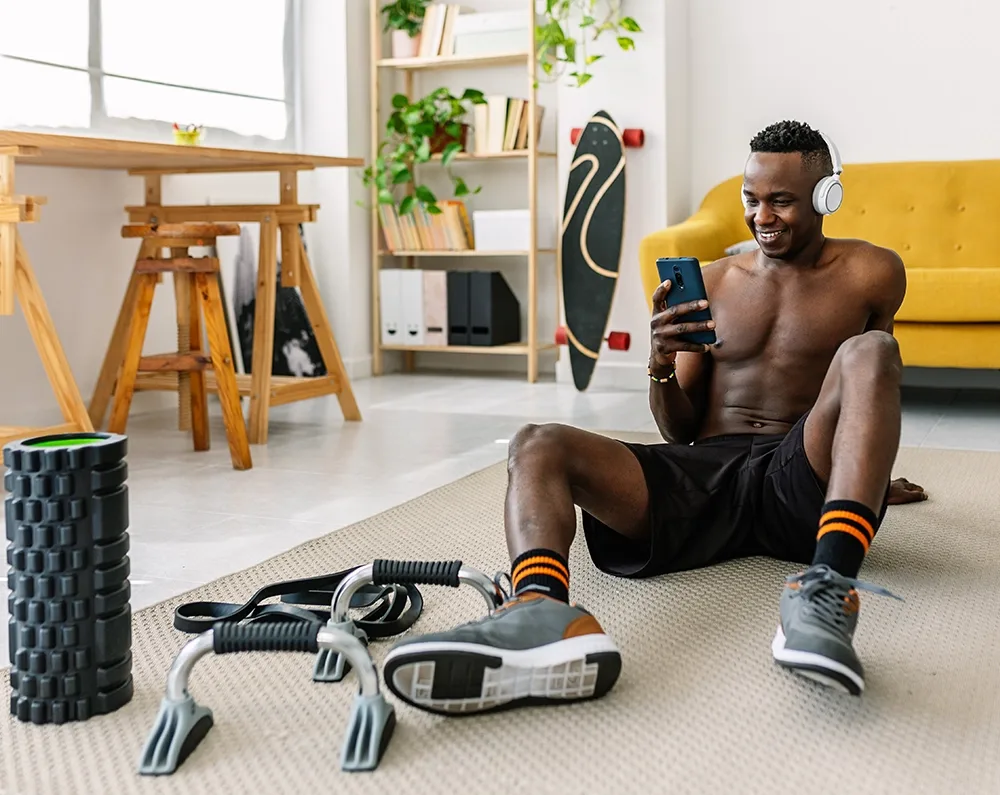
Most people who stop working out don’t run out of motivation. They run out of reasons to leave the house. The gym is twenty minutes away, it’s dark by five, and the plan quietly turns into “next week”.
A home workout without equipment removes the trip. You need a patch of floor about the size of a yoga mat, a wall, and something to keep time. This routine takes 20 to 30 minutes, works your whole body, and has no jumping, so the people downstairs in your condo won’t hear a thing. If you’d rather have someone plan it around your space and watch your form, a Trainer Pro in-home personal trainer comes to you anywhere in Toronto and the GTA.
Can You Get Fit at Home Without Equipment?
Yes, for most people and for a long time. Your body weight is a real load. A push-up puts roughly two thirds of it through your arms and chest, and a lunge puts most of it on your front leg. What matters is whether the last few reps of each set are hard, not where the resistance comes from.
Canada’s 24-Hour Movement Guidelines for adults 18 to 64, from the Canadian Society for Exercise Physiology, recommend muscle-strengthening activities using the major muscle groups at least twice a week. Two sessions of this workout cover that.
The limit shows up in your legs first. Once you can do 20 slow lunges per side, bodyweight alone stops being enough, and that’s when it makes sense to add bands, dumbbells or a slower tempo.
The Workout: 9 Bodyweight Exercises
Do it as a circuit: one set of each exercise in order, a minute of rest, then go round again. Two rounds take about 20 minutes, three take about 30. Warm up first with a minute of marching on the spot, ten arm circles each way and ten slow bodyweight squats.
1. Squat
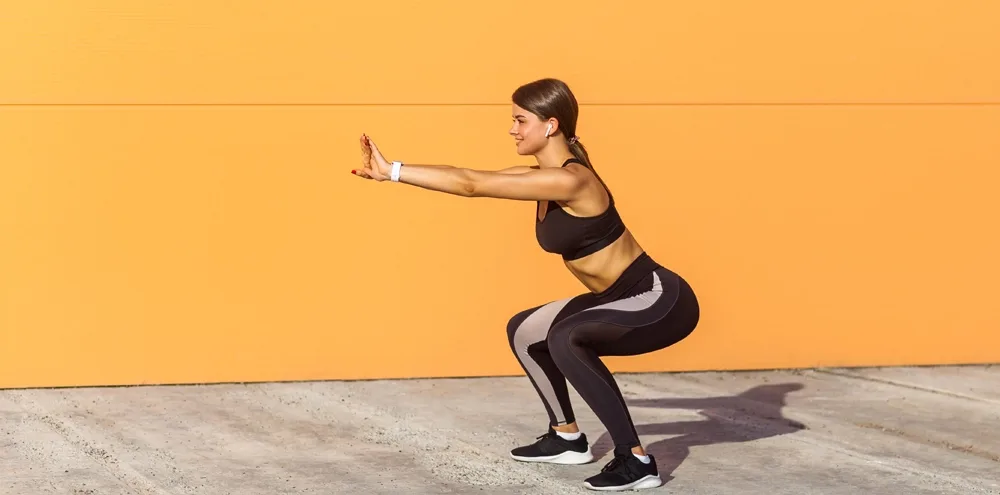
Stand with your feet a little wider than your hips, toes turned slightly out. Sit back and down as if aiming for a low chair, keep your heels on the floor, then stand up. Do 15 reps. If your knees complain, squat to the edge of a real chair and stand back up.
2. Reverse Lunge
Step one foot back and lower until both knees are bent at about 90 degrees, then push through your front heel to stand. Do 10 per leg. Stepping back is easier on the knees than stepping forward, and you can rest a hand on the wall for balance.
3. Glute Bridge
Lie on your back with your knees bent and feet flat. Push through your heels to lift your hips until your body is straight from shoulders to knees, squeeze for two seconds, and lower. Do 15 reps. When that’s easy, do it on one leg.
4. Push-Up
Hands slightly wider than your shoulders, body in one straight line from head to heels. Lower your chest to just above the floor and press back up. Do as many good reps as you can, up to 12. If a full push-up is out of reach, put your hands on the kitchen counter or the back of a sofa. The higher your hands, the easier it gets.
5. Prone Y-Raise
Lie face down with your arms overhead in a Y shape, thumbs pointing up. Lift your arms and chest a few centimetres off the floor, hold for two seconds and lower. Do 12 reps. With no equipment, this is the best way to train your upper back, which most desk workers badly need.
6. Plank Shoulder Tap
Hold a high plank with your feet a bit wider than usual. Tap your left shoulder with your right hand, then switch, keeping your hips as still as you can. Do 10 taps per side. Your core works to stop you rocking, which is most of what it does in everyday life.
7. Dead Bug
Lie on your back with your arms pointing at the ceiling and your knees bent at 90 degrees above your hips. Press your lower back into the floor, then slowly lower your right arm and left leg towards the floor and bring them back. Switch sides. Do 8 per side, slowly.
8. Side Plank
Lie on your side, prop yourself on your forearm and lift your hips so your body forms a straight line. Hold for 20 to 30 seconds per side. Drop your bottom knee to the floor if the full version is too much.
9. Step-Back Burpee
Squat down, put your hands on the floor, step your feet back into a plank one at a time, step them back in and stand up. Do 8 reps at a steady pace. It gets your heart rate up without the thud of a jump, which matters if someone lives below you.
How Often and How Long
Two or three sessions a week on non-consecutive days, so your muscles get a day in between. Is 20 minutes enough? For most people starting out, yes, as long as each set ends close to the point where your form would start to slip.
On a busy day, one round still counts. Ten minutes done beats thirty minutes planned.
How to Make It Harder Without Buying Anything
Change one thing at a time and give it two weeks before the next change. You can slow every rep to three seconds on the way down, pause for a second at the bottom of each squat and lunge, add a third round, or move to harder versions: push-ups from the floor instead of the counter, single-leg glute bridges, a full side plank.
When all of that feels easy, a set of resistance bands is the cheapest next step. Our resistance band workout picks up where this one leaves off.
Training in a Condo or Small Apartment
You need about two metres by one metre of floor. A rug or a folded blanket under your back makes the floor exercises more comfortable. Every move here is low-impact, and the step-back burpee replaces jumping, so you can train at 6 a.m. without a note from the neighbours. If your building has a gym, the same routine works there too.
Common Questions
Can you build muscle without equipment? Yes, especially in your first year of training. Muscle responds to hard sets, and a slow push-up or a single-leg bridge is a hard set for most people. Progress gets slower once you’re strong, which is when added weight starts to matter.
Can I lose weight with home workouts alone? Workouts help, and they protect muscle while you lose fat, but the scale depends mostly on how much you eat. Exercise and food together work far better than either one on its own.
Is this a good home workout for beginners? Yes. Start with one round, the counter push-up and the knee-down side plank, and add a round once the whole thing feels manageable.
What if I have bad knees or a sore back? Squat to a chair, keep the lunges short and skip anything that hurts. If pain is the reason you’ve been avoiding exercise, check with your doctor or physiotherapist before you start.
When a Trainer Helps
The hard part of a home workout isn’t the exercises. It’s doing them on a Tuesday when nobody is expecting you, and noticing that your squat has been getting shallower for three weeks.
A Trainer Pro trainer comes to your home or your condo gym, builds the routine around the space and equipment you have, and changes it as you get stronger. Sessions run from 6 a.m. to 10 p.m., seven days a week, depending on trainer availability, and the first session is free.