
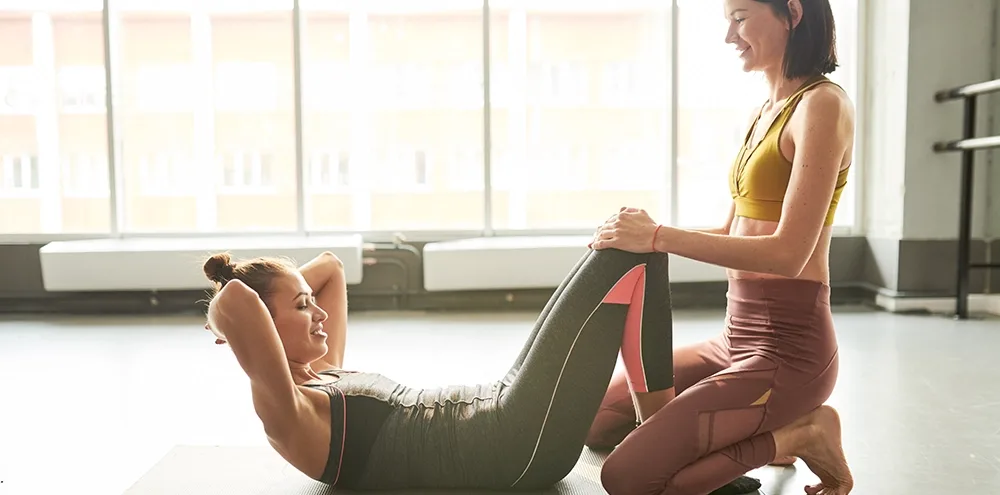
A set of resistance bands fits in a drawer and weighs almost nothing. For a lot of people that’s the whole argument. There’s no commute and no waiting for the cable machine, and the workout starts as soon as you clear a bit of floor in the living room.
This resistance band workout covers your whole body in 20 to 30 minutes, with nine exercises that fit in a condo or a small apartment. If you’d rather have someone set it up around your space and fix your form as you go, Trainer Pro offers in-home personal training across Toronto and the GTA.
Do Resistance Band Workouts Actually Work?
Yes. Muscles respond to tension, and a band gives you plenty of it. The difference from dumbbells is how that tension builds: a band gets harder the further you stretch it, so the top of each rep is the toughest part. That’s easier on your joints at the start of a movement, and it means you can’t coast through the end.
Canada’s 24-Hour Movement Guidelines for adults 18 to 64, from the Canadian Society for Exercise Physiology, recommend muscle-strengthening activities using the major muscle groups at least twice a week. Two band sessions a week cover that.
Where bands fall short is heavy leg work. Strong legs eventually outgrow a band squat, and that’s the point to add dumbbells or slow every rep down.
Choosing Your Bands
Most home workouts use one of three types. Loop bands are long, flat loops you stand on or anchor to something solid. Tube bands have a handle at each end and usually come with a door anchor, which makes rows and presses feel close to a cable machine. Mini bands are short loops that go around your thighs for hip and glute work, and they’re what most “booty band workout” videos use.
Buy a set rather than one band, because your shoulders will need a lighter band than your legs and back. For each exercise, pick the band you can pull 12 times with the last two reps taking real effort.
Resistance Band Exercises at Home: The Full Workout
Do the exercises as a circuit: one set of each, a minute of rest, then go round again. Two rounds take about 20 minutes and three take about 30. The first four make a short resistance band leg workout on their own if you’re pressed for time.
1. Band Squat
Stand on the band with your feet shoulder-width apart and hold the ends at your shoulders. Sit back and down as far as is comfortable, ideally until your thighs are about parallel to the floor, then stand up. Do 12 to 15 reps.
2. Band Romanian Deadlift
Stand on the band and hold the ends in front of your thighs. With your knees slightly bent and your back flat, push your hips back and lower your hands to just below your knees. Stand up by squeezing your glutes. Do 12 reps. It’s the movement that teaches you to pick things up off the floor without rounding your back.
3. Lateral Band Walk
Put a mini band just above your knees and sink into a shallow squat. Take ten small steps to the right, keeping tension on the band the whole time, then ten to the left. These muscles on the outside of your hips keep your knees from caving in when you squat or climb stairs.
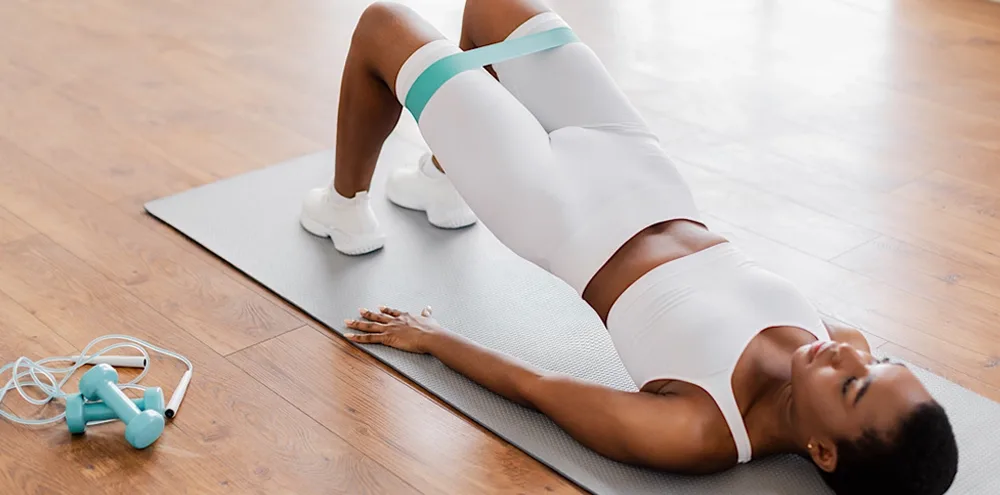
4. Glute Bridge With a Mini Band
Lie on your back with your knees bent and a mini band above your knees. Press your knees out slightly against the band, lift your hips until your body is straight from shoulders to knees, and hold for two seconds. Do 12 to 15 reps.
5. Bent-Over Band Row
The next four are the resistance band arm workout part of the session, along with your back and shoulders. Stand on the band, hinge forward at the hips to about 45 degrees and let your arms hang. Pull the handles towards your lower ribs, squeeze your shoulder blades together and lower slowly. Do 12 reps.
6. Standing Band Chest Press
Anchor the band in a door at chest height and face away from it. Step forward until there’s tension, then press your hands straight out in front of you and bring them back under control. Do 12 reps. A staggered stance, one foot ahead of the other, keeps you from being pulled backwards.
7. Band Overhead Press
Stand on the band with the handles at your shoulders and press them straight up until your arms are almost straight. Lower over three seconds. Do 10 reps. If pressing overhead pinches your shoulder, stop at the height where it feels fine.
8. Face Pull
Anchor the band at face height. Hold the ends with your palms facing down and pull them towards your forehead, elbows high and wide. Do 15 reps. If you spend your day hunched over a laptop, this is the exercise to keep.
9. Pallof Press
Anchor the band at chest height and stand side-on to the door. Hold the handle at your chest with both hands, press it straight out and hold for two seconds without letting the band twist you towards the anchor. Do 10 reps on each side. It trains your core to resist rotation, which is most of what your core does in daily life.
How Long and How Often
Is 20 minutes of resistance training enough? For most people, yes, as long as the last few reps of each set are hard. Train two or three times a week on non-consecutive days, which leaves a day in between for your muscles to recover.
How to Make It Harder
Change one thing at a time and give it two weeks before the next change. You can hold the band lower or stand with your feet wider to shorten it, move up to a thicker band, take three seconds to lower each rep, pause for a second at the hardest point, or add a third round.
Staying Safe With Bands
Check your bands for small nicks or thin spots before every session, and replace any that look worn. A band that snaps mid-rep can leave a welt. Anchor door straps on the hinge side, close the door fully and pull away from the opening. Never let go of a band while it’s stretched.
Common Questions
Can you build muscle with resistance bands? Yes, especially if you’re new to strength training. The key is the same as with weights: sets that end close to your limit, and a heavier band once 15 reps feel easy.
How do I tone my stomach with resistance bands? No exercise burns fat from one spot. The Pallof press and other core work will make your stomach muscles stronger, but whether you can see them depends on your overall activity and what you eat.
Are resistance bands good for beginners? They’re one of the easiest places to start. The tension is light at the beginning of each rep, and you can make an exercise easier on the spot by stepping closer to the anchor.
When a Trainer Helps
Bands are easy to buy and easy to use badly. Most people pick a band that’s too light or rush the lowering phase, and they don’t notice because nobody’s watching.
A Trainer Pro trainer comes to your home or your condo gym and builds the routine around your space and whatever equipment you already have. If you’re still deciding between training at home and a gym membership, our comparison of in-home personal training vs the gym goes through the trade-offs. Sessions run from 6 a.m. to 10 p.m., seven days a week, depending on trainer availability, and the first session is free.