
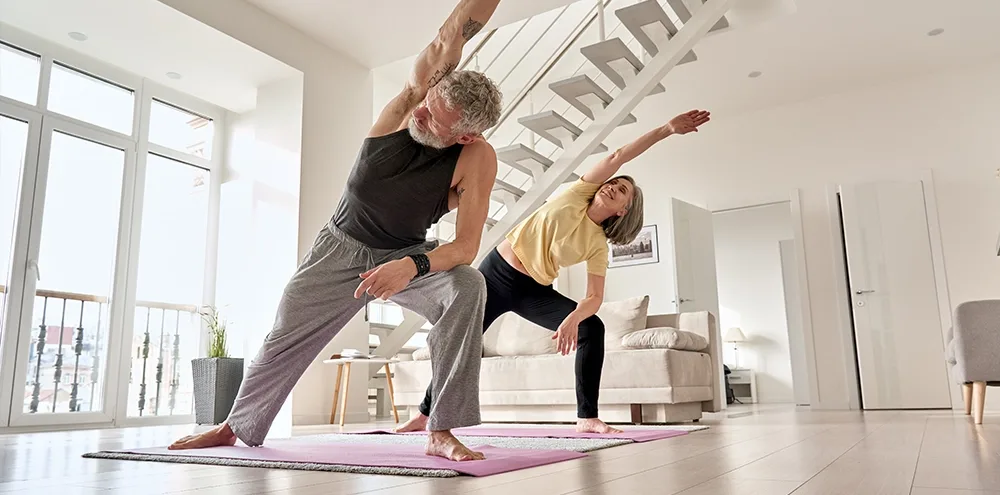
Ask someone in their seventies what has changed, and stiffness usually comes up before strength. The top shelf feels higher than it used to. Checking your blind spot on the 401 means turning your whole body. Putting on socks takes a chair. None of it happened overnight, and it won’t go away overnight either. But ten minutes of stretching most days makes a difference most people can feel within a few weeks.
Below are ten stretching exercises for seniors that need nothing more than a sturdy chair, a wall and a kitchen counter. None of them ask you to get down on the floor. If you’d like someone to check your position and work the routine around a sore hip or a new knee, a Trainer Pro personal trainer for seniors comes to your home or condo gym across Toronto and the GTA.
What Type of Stretching Is Best for Seniors?
Both kinds have a job. Dynamic stretching means moving gently through a range of motion: arm circles, marching on the spot, slow leg swings while holding a counter. It warms you up, so it’s the better choice before a walk or a workout. Static stretching means easing into a position and holding it. That’s what improves flexibility over time, and it’s what most of this guide covers.
The American College of Sports Medicine recommends stretching at least two or three days a week and says daily stretching works best. Most adults hold a stretch for 10 to 30 seconds, but in older people, holding for 30 to 60 seconds may do more for flexibility (ACSM). Go to the point of mild tightness. Never into pain.
Before You Start
Warm up first. Cold muscles don’t stretch well, so march on the spot for a minute or two and roll your shoulders, or save your stretches for after a walk.
Use a chair without wheels, pushed against a wall so it can’t slide. Wear shoes with grip. Breathe slowly and keep breathing. Holding your breath makes you tense up, and that works against the stretch.
If you’ve had a hip or knee replacement, back surgery or a recent injury, ask your physiotherapist or doctor which positions to avoid. After some hip replacements, for example, crossing your legs or bending the hip past 90 degrees is off limits for a while. That rules out stretch 9 below until you’re cleared.
10 Stretching Exercises for Seniors
Start by holding each stretch for 20 to 30 seconds, and work up to 30 to 60 seconds as it gets comfortable. Do each one twice per side. Move into every position slowly, and don’t bounce.
1. Neck Side Stretch
Sit tall with your feet flat and hold the side of the seat with your right hand. Slowly tilt your left ear toward your left shoulder until you feel a stretch along the right side of your neck. Keep your shoulders level and your chin pointing forward. Switch sides. If tilting your head makes you dizzy, keep the movement small or skip it.
2. Cross-Body Shoulder Stretch
Sit or stand. Bring your right arm across your chest and press gently just above the elbow with your left hand, drawing the arm closer. You’ll feel it at the back of the shoulder. Keep that shoulder down, away from your ear. Switch arms. If the front of the shoulder pinches, lower the arm a little.
3. Doorway Chest Stretch
Stand in a doorway with your forearms on the frame, elbows a little below shoulder height. Step one foot forward slowly until you feel a stretch across the front of your chest and shoulders. This one counters the rounded posture that builds up from reading, phones and long drives. Easier: do one arm at a time against a wall.
4. Upper Back Stretch
Sit near the front of the chair. Clasp your hands at chest height, palms facing away from you. Push your hands forward and let your upper back round, as if you’re hugging a big beach ball, with your chin dropped slightly. You’ll feel it between your shoulder blades.

5. Seated Hamstring Stretch
Sit on the front edge of the chair. Straighten your right leg with the heel on the floor and toes pointing up, and keep your left foot flat. With a straight back, lean forward from the hips until you feel a stretch behind your right thigh. Don’t reach for your toes; a rounded back moves the stretch to the wrong place. Switch legs. Tight hamstrings pull on the lower back, which is one reason bending down to tie your shoes gets harder.
6. Standing Calf Stretch
Face a wall with your hands on it at shoulder height. Step your right foot back, keep the heel down and the leg straight, and bend your front knee until you feel the right calf stretch. Then bend the back knee slightly to reach the lower calf. Switch. Tight calves shorten your stride and make it easier to catch a toe on a curb or the edge of a rug.
7. Standing Quad Stretch at the Counter
Hold the counter with your left hand. Bend your right knee, bring your heel toward your buttock and hold your ankle with your right hand. Keep your knees side by side and stand tall. If you can’t reach, loop a towel around your ankle and hold the ends. Switch legs. Skip this one until standing on one leg feels steady; the next stretch covers part of the same area.
8. Hip Flexor Stretch
Stand side-on to the counter and hold it with one hand. Take a long step forward with your left foot, as if starting a lunge, and let your right heel lift. Tuck your tailbone under a little and shift your weight forward until you feel a stretch at the front of your right hip. Keep your upper body upright. Switch. Hours of sitting tighten these muscles, and tight hip flexors make it harder to stand fully upright.
9. Seated Figure-Four Stretch
Sit tall and cross your right ankle over your left knee, letting the right knee drop out to the side. If you need more, lean forward slightly from the hips with a straight back. You’ll feel it deep in the right buttock. Switch. If lifting your ankle that high is a struggle, rest it on your shin instead. Skip this one after a hip replacement until you’ve been cleared to cross your legs.
10. Wrist and Finger Stretch
Hold your right arm out in front of you, palm up. With your left hand, gently pull your fingers back until you feel a stretch along the underside of your forearm. Then turn the palm down and ease the back of your hand toward you. Switch. A minute of this before gardening, knitting or typing can take the edge off stiff hands. Go gently if you have arthritis in your fingers or wrists.
A 10-Minute Daily Stretching Routine
Warm up for two minutes by marching on the spot and rolling your shoulders. Then go through the ten stretches in order, once per side, holding each for about 30 seconds. That takes around eight minutes. With more time, do a second round.
On busy days, a five-minute version still helps: the neck stretch, doorway chest stretch, seated hamstring, calf and hip flexor. Those five cover the spots that tighten most from sitting.
Morning or evening both work. A short routine after you get up eases first-thing stiffness, but your muscles are warmer later in the day, so you may get further in the evening. The best time is the one you’ll actually keep.
Can a 70-Year-Old Regain Flexibility?
Yes. Muscles respond to regular stretching at any age, though progress is slower than it was at 40. Most people notice a difference after a few weeks of stretching most days, and the gains fade if you stop for long.
Flexibility is only half of moving well. Being loose enough to step over the side of the bathtub is one part; having the strength and steadiness to do it safely is the other. Our guide to balance exercises for seniors pairs well with this routine.
When to Stop
A stretch should feel like mild tension that eases as you hold it. Stop if you feel sharp or shooting pain, numbness or tingling, or pain in a joint rather than in the muscle. Sit down if you get dizzy, which can happen when you stand up quickly after a seated stretch. If a stretch hurts the same way two sessions in a row, get it checked.
Common Questions
How often should seniors stretch? At least two or three days a week, and daily if you can. Short daily sessions do more than one long session a week.
Should I stretch before or after a walk? Do gentle moving stretches before, like marching and arm circles. Save the held stretches for after, when your muscles are warm.
Can I do all of these sitting down? Five of the ten are seated already. The calf, quad and hip flexor stretches are easier standing, so hold the counter and use them if your balance allows.
Is it normal to feel sore after stretching? A mild ache the next day can happen when you start, but it shouldn’t last. If you’re sore, you went too far. Ease off next time.
When a Trainer Helps
Stretching looks simple, and mostly it is. It goes wrong in the details: a back that rounds in the hamstring stretch, a position that’s off limits after surgery, or a tight spot that’s really a weak muscle.
A Trainer Pro trainer comes to your home or building gym, checks how you move, and builds stretching into a routine with the strength and balance work you need. Family members are welcome on the first consultation, sessions run 6 a.m. to 10 p.m., seven days a week, depending on trainer availability, and the first session is free.